

Twin Engine Marine Applications: The Complete Guide
Everything you need to know about twin engine configurations for optimal marine performance and safety
Introduction
Twin engine marine applications represent the gold standard in marine propulsion for vessels where performance, safety, and redundancy are paramount. Whether you’re operating a luxury yacht, commercial fishing vessel, or offshore patrol boat, understanding twin engine configurations is crucial for optimal vessel performance. At Wave Inboard Motors, our extensive experience with 【Marine Engine Installation Services】 for both single and twin configurations gives us unique insight into selecting the right propulsion system for your specific needs.
This comprehensive guide explores the benefits, considerations, and technical aspects of twin engine setups, helping you make an informed decision about your vessel’s propulsion system. From increased safety to improved maneuverability, we’ll cover why twin engines are the preferred choice for serious mariners and commercial operators alike.
Why Choose Twin Engines? Key Benefits
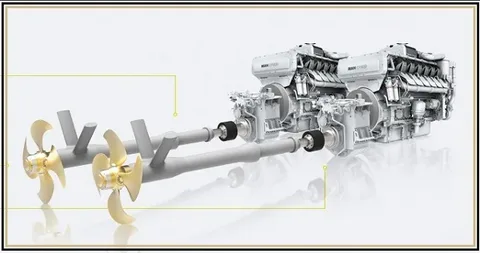
[Image: Diagram showing twin engine configuration with counter-rotating propellers]
Image Caption: Twin engines with counter-rotating propellers provide superior maneuverability and eliminate propeller torque.
1. Enhanced Safety & Redundancy
-
Complete propulsion redundancy
-
Ability to return to port on one engine
-
Emergency maneuverability in critical situations
-
Reduced risk of complete power loss
2. Superior Maneuverability
-
Independent engine control for precise docking
-
Counter-rotating propeller setups
-
Pivot turns and sideways movement capability
-
Enhanced control in tight marinas and difficult conditions
3. Performance Optimization
-
Better weight distribution across the hull
-
Optimized power-to-weight ratio
-
Improved stability and seakeeping
-
Flexible power management options
Twin Engine Configuration Comparison
| Configuration | Traditional Shaft Drives | Pod Drives (IPS) | Sterndrives |
|---|---|---|---|
| Best For | Commercial vessels, heavy displacement yachts | Luxury yachts, performance vessels | Smaller craft, express cruisers |
| Efficiency | Good | Excellent (30% better) | Moderate |
| Maneuverability | Good | Exceptional | Very Good |
| Maintenance | Simpler mechanical systems | Specialized required | Complex |
| Installation | Straightforward | Complex integration | Moderate |
Twin Engine Applications by Vessel Type
Luxury Yachts (40-80 feet)
-
Recommended: 【Volvo Penta IPS Systems】 or traditional shaft drives
-
Benefits: Quiet operation, fuel efficiency, joystick control
-
Considerations: Space requirements, maintenance complexity
Commercial Fishing Vessels
-
Recommended: Traditional shaft drives with mechanical engines
-
Benefits: Reliability, repairability at sea, proven durability
-
Considerations: Fuel consumption, vibration levels
High-Performance Sportfish
-
Recommended: 【Volvo Penta D6/D8 Series】 with shaft drives
-
Benefits: Torque for fighting fish, reliability, speed
-
Considerations: Weight distribution, engine access
Patrol & Rescue Vessels
-
Recommended: Water jet or pod systems
-
Benefits: Maneuverability, shallow-water capability, acceleration
-
Considerations: Specialized training, maintenance requirements
Technical Considerations
Engine Synchronization
-
Electronic engine synchronization systems
-
Matched propeller sizing and pitch
-
Balanced engine hours and maintenance
-
Professional 【Marine Engine Diagnostic Service】 requirements
Installation Requirements
-
Precise engine alignment
-
Shaft angle optimization
-
Fuel system design
-
Exhaust system routing
-
Electrical system capacity
Maintenance Considerations
-
Synchronized maintenance schedules
-
Balanced engine hours
-
Professional 【Scheduled Marine Diesel Maintenance】
-
Spare parts inventory management
Twin vs Single Engine: Decision Matrix
| Factor | Choose Twin Engines When: | Choose Single Engine When: |
|---|---|---|
| Safety | Offshore operations, commercial use | Protected waters, daytime use |
| Maneuverability | Large vessels, tight docking | Smaller vessels, open docks |
| Redundancy | Professional operations, charter | Recreational, coastal cruising |
| Budget | Higher initial investment acceptable | Limited budget, cost-sensitive |
| Space | Adequate engine room space | Severe space constraints |
Frequently Asked Questions (FAQ)
Q1: How much more does a twin engine setup cost compared to a single engine?
A: Twin engine installations typically cost 60-80% more than equivalent single engine setups, considering duplicate engines, controls, and more complex installation requirements. However, the investment often pays dividends in safety, resale value, and operational flexibility.
Q2: Can I mix different engine brands in a twin configuration?
A: While technically possible, we strongly recommend against mixing brands. Matched engines ensure balanced performance, synchronized maintenance, and simplified spare parts inventory. Always use identical engines for optimal performance.
Q3: What is the fuel consumption difference between twin and single engines?
A: Modern twin engine setups can be surprisingly efficient. While you’re carrying the weight of two engines, advanced systems like 【Volvo Penta IPS】 actually provide better fuel efficiency than traditional single engine configurations due to superior propulsion efficiency.
Q4: How do I maintain synchronized engine hours?
A: Implement a strict 【Scheduled Marine Diesel Maintenance】 program that includes:
-
Regular engine hour monitoring
-
Balanced operational patterns
-
Synchronized maintenance intervals
-
Professional monitoring systems
Q5: What happens if one engine fails at sea?
A: With a properly configured twin engine setup, you can typically maintain 60-70% of your normal cruising speed on one engine. This safety feature is invaluable for offshore passages and commercial operations.
Q6: Are twin engines harder to maintain?
A: While there are two engines to maintain, modern electronic systems actually simplify maintenance through synchronized service intervals and comprehensive monitoring systems. Professional maintenance is essential for optimal performance.
Q7: What about propeller rotation in twin engine setups?
A: Counter-rotating propellers are standard in twin engine configurations. This eliminates propeller torque, improves straight-line tracking, and enhances low-speed maneuverability.
Q8: Can I retrofit twin engines to a single-engine boat?
A: Retrofitting is possible but requires significant structural modifications. We recommend a comprehensive 【Marine Engine Diagnostic Service】 to assess hull compatibility and structural requirements before considering such a project.
Q9: How does twin engine configuration affect resale value?
A: Twin engine vessels typically command a 20-30% premium over equivalent single-engine vessels due to their enhanced safety, maneuverability, and redundancy features.
Q10: What training is required for twin engine operation?
A: While basic operation is similar to single engines, mastering advanced maneuvering techniques requires specific training. We provide comprehensive operator training with every twin engine installation.
Professional Services & Support
At Wave Inboard Motors, we provide comprehensive support for twin engine applications:
-
【Marine Engine Installation Services】 – Professional twin engine installation and calibration
-
【Scheduled Marine Diesel Maintenance】 – Synchronized maintenance programs
-
【Marine Engine Diagnostic Service】 – Comprehensive system analysis
-
Operator Training – Advanced maneuvering instruction
-
24/7 Support – Emergency service and technical support
Conclusion
Twin engine marine applications offer unparalleled safety, performance, and operational flexibility for serious boaters and commercial operators. While requiring greater initial investment and more sophisticated maintenance, the benefits in redundancy, maneuverability, and peace of mind make twin engines the preferred choice for vessels where performance and safety cannot be compromised.
Ready to explore twin engine options for your vessel? Contact Wave Inboard Motors for a professional consultation and discover how twin engine propulsion can transform your boating experience.


