


Understanding Common Rail Diesel Systems: The Complete Guide
How advanced high-pressure fuel injection technology revolutionized marine diesel performance and efficiency.
Introduction
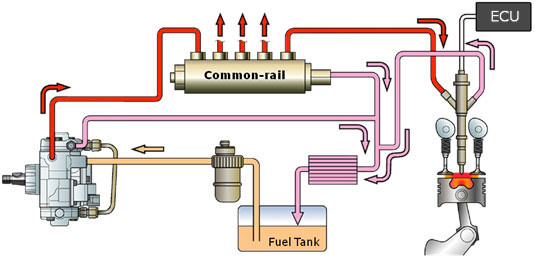
[Image: A detailed diagram showing the components of a common rail system – high-pressure pump, rail, injectors, and ECU]
Image Caption: Common rail systems separate pressure generation from injection, allowing precise electronic control over fuel delivery.
Common Rail Diesel (CRDi) technology represents the most significant advancement in marine diesel engineering since the advent of turbocharging. This sophisticated fuel injection system has fundamentally transformed how marine engines perform, delivering unprecedented levels of power, efficiency, and environmental compliance. At Wave Inboard Motors, our daily work with 【Marine Engine Diagnostic Service】 on common rail systems has given us unique insight into both their capabilities and maintenance requirements.
Unlike traditional diesel injection systems where fuel pressure is generated separately for each injection event, common rail systems maintain constant high pressure in a central “rail” that supplies all injectors. This revolutionary approach, controlled by sophisticated electronic management, enables multiple precise injection events per combustion cycle. The result is cleaner, more efficient combustion that has made modern marine engines like the 【Volvo Penta D4 Series】 so remarkably refined and economical.
How Common Rail Systems Work: The Core Components
1. High-Pressure Fuel Pump
-
Function: Generates extreme pressure (up to 35,000 psi/2,500 bar)
-
Operation: Driven by the engine, often at half engine speed
-
Key Feature: Maintains constant pressure regardless of engine RPM
-
Maintenance: Sensitive to fuel contamination – requires clean fuel
2. Common Rail (Fuel Accumulator)
-
Function: Stores high-pressure fuel and dampens pulses
-
Design: Heavy-walled tube running along the cylinder head
-
Capacity: Maintains stable pressure for all injectors
-
Pressure Sensors: Monitor and regulate rail pressure
3. Electronic Injectors
-
Function: Precisely timed fuel delivery into cylinders
-
Control: Solenoid or piezo-electric actuation
-
Speed: Can open/close in milliseconds
-
Precision: Microscopic tolerances for exact fuel metering
4. Engine Control Unit (ECU)
-
Function: The “brain” managing entire system
-
Inputs: Monitors engine speed, load, temperature, pressure
-
Outputs: Controls injector timing, duration, and pattern
-
Adaptation: Continuously optimizes for conditions
The Injection Revolution: Multiple Injection Events
[Image: Graph showing multiple injection events – pilot, main, post]
Image Caption: Multiple injection events per cycle enable cleaner, quieter, and more efficient combustion.
Pilot Injection
-
Timing: Tiny fuel amount injected before main event
-
Benefit: Gently begins combustion, reducing “diesel knock”
-
Result: Up to 50% reduction in combustion noise
Main Injection
-
Timing: Primary fuel delivery for power
-
Benefit: Optimized timing for maximum efficiency
-
Result: Complete combustion, minimal smoke
Post Injection
-
Timing: Small injection after main combustion
-
Benefit: Burns remaining particulates
-
Result: Reduced emissions, cleaner exhaust
Common Rail vs. Traditional Injection Systems
| Feature | Common Rail System | Traditional Injection |
|---|---|---|
| Injection Pressure | Constant high pressure (25,000-35,000 psi) | Varies with RPM (5,000-20,000 psi) |
| Injection Control | Electronic, multiple injections per cycle | Mechanical, single injection |
| Noise Level | Quiet and smooth | Pronounced diesel knock |
| Fuel Efficiency | 15-30% better | Standard |
| Emissions | Low (meets Tier 3) | Higher |
| Complexity | High (electronic precision) | Low (mechanical simplicity) |
| Maintenance | Requires clean fuel, professional service | More tolerant, field-serviceable |
Benefits for Marine Applications
1. Exceptional Fuel Efficiency
-
Optimal combustion across entire RPM range
-
Precise fuel metering matched to load demands
-
Reduced fuel consumption by 15-30%
-
Longer range from same fuel capacity
2. Superior Performance
-
Instant throttle response without turbo lag
-
Smooth power delivery from low to high RPM
-
Higher power density from same displacement
-
Better load carrying capability
3. Reduced Environmental Impact
-
Lower emissions meeting IMO Tier 3 standards
-
Cleaner exhaust with minimal visible smoke
-
Reduced noise pollution for quieter operation
-
Improved combustion efficiency
4. Enhanced Reliability
-
Constant pressure reduces component stress
-
Electronic monitoring provides early fault detection
-
Adaptive operation compensates for wear
-
Comprehensive diagnostics through systems like 【Volvo Penta EVC】
Maintenance & Service Considerations
Critical Maintenance Requirements
-
Fuel Quality: Absolute requirement for clean, dry fuel
-
Filter Changes: Regular replacement of primary and secondary filters
-
System Diagnostics: Professional scanning for fault codes
-
Professional Service: Requires certified technicians and specialized tools
Common Service Intervals
-
Every 250-500 hours: Fuel filter replacement
-
Annual: System pressure testing
-
Every 1,000 hours: Injector performance testing
-
As needed: ECU software updates
Potential Failure Points
-
Injectors: Clogging from contaminated fuel
-
High-pressure pump: Wear from water in fuel
-
Rail pressure sensors: Electronic failure
-
Fuel lines: Fatigue from extreme pressure cycling
Frequently Asked Questions (FAQ)
Q1: Why is fuel quality so critical for common rail systems?
A: The microscopic tolerances in injectors and high-pressure pumps (often less than 1/10th human hair) are easily damaged by water, dirt, or algae in fuel. Even minor contamination can cause catastrophic damage requiring expensive repairs.
Q2: How does common rail technology reduce engine noise?
A: The pilot injection gently begins combustion before the main injection event, eliminating the sudden pressure spike that causes traditional diesel “knock.” This makes modern diesels remarkably quiet.
Q3: Can common rail systems be repaired at sea?
A: Generally no. The high pressures and electronic precision require specialized tools, clean environments, and diagnostic equipment. This underscores the importance of preventive 【Scheduled Marine Diesel Maintenance】.
Q4: What’s the typical service life of common rail components?
A: With proper maintenance and clean fuel:
-
Injectors: 5,000-8,000 hours
-
High-pressure pump: 8,000-10,000 hours
-
Common rail: 10,000+ hours
-
Electronic controls: 10,000+ hours
Q5: How does common rail technology work with turbocharging?
A: They’re perfectly complementary. Common rail provides precise fuel control while turbocharging optimizes air delivery. Systems like 【Volvo Penta DPI Turbo Technology】 integrate both for exceptional performance.
Q6: Are common rail engines more expensive to maintain?
A: Initially yes, due to specialized parts and service requirements. However, the significantly better fuel efficiency often offsets these costs over the engine’s lifespan.
Q7: What happens during a common rail system failure?
A: The ECU typically detects abnormal pressures and will derate engine power or shut down completely to prevent damage. Professional 【Marine Engine Diagnostic Service】 is required to identify and resolve the issue.
Q8: Can biodiesel be used in common rail systems?
A: Most manufacturers approve low-percentage blends (B5-B10) but caution against higher concentrations due to potential seal degradation and injector coking.
Q9: How have common rail systems evolved?
A: Systems have progressed through multiple generations with increasing pressures (from 1,500 bar to 2,500+ bar), faster injectors, and more sophisticated electronic control.
Q10: What’s the future of common rail technology?
A: Expect even higher pressures (3,000+ bar), faster piezo injectors, and integration with hybrid and alternative fuel systems for next-generation marine propulsion.
Conclusion: The New Standard in Marine Propulsion
Common rail diesel technology has fundamentally transformed marine propulsion, delivering unprecedented levels of efficiency, performance, and environmental compliance. While requiring more sophisticated maintenance than traditional systems, the benefits in fuel economy, quiet operation, and reduced emissions make common rail the clear choice for modern marine applications.
From the compact 【Vetus VH4.65】 to the powerful 【Volvo Penta D6 Series】, common rail technology has become the foundation for efficient, reliable marine propulsion across all vessel types and power ranges.
Need expert common rail service or considering upgrading to modern diesel technology? Contact Wave Inboard Motors for professional 【Marine Engine Diagnostic Service】 and 【Marine Engine Repowering Solutions】 tailored to your vessel’s needs.
Authority-Building Internal Links
Link to Services:
-
Professional 【Marine Engine Diagnostic Service】 for common rail systems
-
Explore 【Marine Engine Repowering Solutions】 with modern diesel technology
-
Maintain reliability with 【Scheduled Marine Diesel Maintenance】 programs
-
Trust our 【Marine Engine Installation Services】 for precision work
Link to Information:
-
Learn about 【Volvo Penta DPI Turbo Technology】
-
Compare engines in our 【Marine Diesel Engine Comparison Guide】
-
Read our 【Understanding Modern Marine Emissions Standards】
-
Calculate costs with 【Calculating the True Cost of a Marine Repower】