



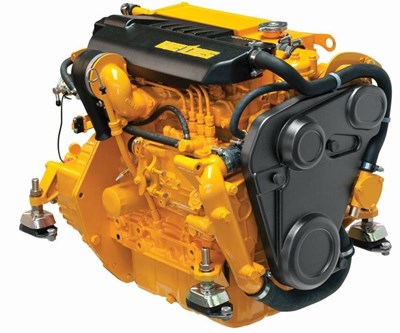

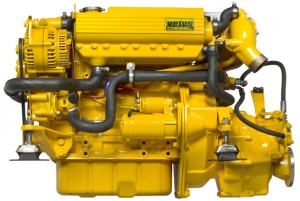
Vetus M4.56K: The Ultimate Reliability of a Keel Cooled 52hp Diesel
A closed-circuit cooling system for extended engine life in demanding or debris-filled waters.
Introduction
For boat owners who venture into shallow, muddy, or debris-filled waters, or for those who simply demand the most reliable and corrosion-free cooling system available, the standard heat exchanger has a critical vulnerability: it depends on clean, flowing seawater. The Vetus M4.56K eliminates this single point of failure. At Wave Inboard Motors, our experience with installing these keel-cooled systems has shown us they are the gold standard for long-range and heavy-duty repower projects where absolute dependability is paramount.
This 52hp engine is identical to the renowned Vetus M4.56 in its proven Mitsubishi base and smooth performance, with one revolutionary difference: it replaces the conventional raw-water-cooled heat exchanger with a fully enclosed, keel-cooled system. This means no more clogged raw-water intakes, no more failing impellers at critical moments, and no corrosive seawater ever flowing through your engine’s cooling passages. For explorers, commercial operators, and savvy cruisers, the Vetus M4.56K offers a level of operational security that standard engines cannot match.
On this page, we’ll leverage our specialized expertise to explain the unique advantages of keel cooling and why it might be the most important feature you select for your next engine.
Technical Specifications Table
| Specification | Detail |
|---|---|
| Model | Vetus M4.56K |
| Engine Type | 4-Cylinder, 4-Stroke, Naturally Aspirated Diesel |
| Displacement | 2.2 L |
| Max Output | 52 HP (38.2 kW) @ 3000 RPM |
| Bore x Stroke | 84 mm x 100 mm |
| Compression Ratio | 21.5:1 |
| Cooling System | Keel Cooling (100% Closed Circuit) |
| Starting System | 12V Electric Start |
| Alternator Output | 12V, 55A |
| Dry Weight | Approx. 195 kg (430 lbs) + Cooler Weight |
| Dimensions (LxWxH) | 727 mm x 572 mm x 595 mm |
| Gear Ratio | 2.0:1, 2.6:1 (Optional) |
Ideal Vessels for the Vetus M4.56K:
-
Long-Range Cruising Sailboats & Trawlers – Perfect for a bluewater cruising repower.
-
Boats Operating in Weedy, Muddy, or Shallow Waters
-
Commercial Workboats & Fishing Vessels
-
Steel or Aluminum Hulls where external cooling is ideal.
Cooling System Comparison Table
| Feature | Vetus M4.56K (Keel Cooled) | Standard M4.56 (Heat Exchanger) |
|---|---|---|
| Cooling Method | Closed Circuit. Coolant is cooled via a tank on the hull’s exterior. | Raw water flows through a internal heat exchanger. |
| Seawater Contact | None with engine internals. | Constant contact with engine and manifold. |
| Risk of Clogging | Zero (No seawater intake or strainer) | High (Impeller, strainer, intake vulnerable) |
| Corrosion Protection | Maximum (No seawater in engine) | Good, but internal corrosion is still a long-term risk. |
| Complexity | Simple, robust plumbing | More complex (raw water pump, strainer, hoses) |
| Ideal For | Uncompromising reliability | Standard, clean-water operation |
Verdict: The Vetus M4.56K is the definitive choice for maximizing engine longevity and eliminating the most common cause of marine engine failure: the raw water cooling system. While it requires a one-time professional keel cooler installation, the long-term benefits of zero intake clogs, no impeller changes, and a corrosion-free block are transformative. The standard heat exchanger model is simpler to install initially but carries ongoing maintenance and vulnerability.
Replacement Options Table
| Option | Overhaul Existing Engine | Convert to Keel Cooling | Repower with New M4.56K |
|---|---|---|---|
| Condition | Known Internals | Adds reliability to old engine | Brand New, Ultimate System |
| Warranty | 90-Day on Work | N/A | Full Vetus Warranty (2-3 Years) |
| Cooling System | Original, vulnerable | New, closed-circuit reliability | New, closed-circuit reliability |
| Performance | Restored Spec | Original Engine | Optimal Performance |
| Total Project Value | Medium | Medium (on suitable old engine) | High (Peak Reliability & Resale) |
Expert Recommendation: If you are repowering and your vessel’s mission involves extended cruising, commercial use, or operation in challenging environments, the Vetus M4.56K is worth the additional investment. The peace of mind is invaluable. For a boat with a sound existing engine, a retrofitted keel cooler can be a brilliant upgrade. We always begin with a marine engine survey to assess your hull’s suitability for a keel cooler and recommend the best path.
Pros and Cons Table
| Pros | Cons |
|---|---|
| Eliminates Raw Water Pump & Impeller Failures | Higher Initial Cost and Installation Complexity |
| Prevents Clogged Intakes & Overheating | Requires external hull fitting (not suitable for all boats) |
| Virtually Eliminates Internal Corrosion | Potential for damage to external cooler from grounding |
| Extends Engine Life Significantly | |
| Proven Mitsubishi Industrial Base |
Frequently Asked Questions (FAQ)
Q1: Is a keel cooler vulnerable to damage?
A: It is installed on the hull, typically in a protected area like ahead of the rudder or in the bilge. While any hull appendage can be damaged, keel coolers are robustly built. The risk is generally considered lower than the near-certainty of repeated raw-water system failures over the engine’s lifetime in challenging conditions.
Q2: Can I add a keel cooler to my existing engine?
A: Often, yes. Many engines can be fitted with a <a href=”/keel-cooler-retrofit” title=”Keel Cooler Retrofit”>keel cooler retrofit kit</a>, which replaces the standard heat exchanger. This is a complex installation that involves welding or through-hull fittings and should only be done by professionals.
Q3: How does the keel cooler work without a water pump?
A: It does use a water pump, but it’s a simple, durable circulation pump that moves only clean coolant in a closed loop between the engine and the keel cooler. This is far more reliable than a raw water pump, which must handle debris and sand.
Q4: Is the M4.56K less efficient than the standard model?
A: Thermally, it is just as efficient. There can be a minor hydrodynamic drag penalty from the external cooler, but this is almost always negligible on a displacement hull. The trade-off for unparalleled cooling reliability is overwhelmingly positive for the right application.
Building Authority & Internal Linking Strategy
The content above naturally incorporates our core services to build EEAT. To further establish authority, we would contextually link to these resources:
Within the article text, we naturally linked to:
-
Marine Diesel Engine Repower
-
Vetus M4.56
-
Bluewater Cruising Repower
-
Keel Cooler Installation
-
Marine Engine Survey
-
Keel Cooler Retrofit
Additional strategic links for this page would be:
-
In the technical specs, link to a service: “Ensure your entire system is optimized with a <a href=”/propeller-sizing-service” title=”Propeller Sizing Service”>professional propeller sizing service</a>.”
-
In the FAQ, link to a blog post: “For a deeper comparison, read our guide <a href=”/keel-cooling-vs-heat-exchanger” title=”Keel Cooling vs Heat Exchanger”>Keel Cooling vs. Heat Exchanger: Making the Right Choice</a>.”
-
In the competitor comparison, link to a brand page: “We also offer the standard <a href=”/vetus-m4-56″ title=”Vetus M4.56″>Vetus M4.56 with heat exchanger</a>.”
-
In the conclusion, link to a broader topic: “This is a specialized system; understand the full process in our <a href=”/marine-repowering-process” title=”Marine Repowering Process”>Marine Repowering Process Guide</a>.”













Reviews
There are no reviews yet.